Friday, August 26, 2011

Disney's "The Help"


I used to have this fond memory of going to the drive-in when I was 7 or 8 to see a Disney movie. I couldn't remember the name of it, only that it was a mix of live-action and animation and it was pure magic. In my late teens and early twenties, I tried in vain to find this movie, hoping I'd discover it someday and have a giddy nostalgia trip courtesy of Blockbuster Video. Not until I reached grad school did I find out what this movie was. For me, grad school was mostly about finding out that global media companies are evil. We were discussing said evilness in class one day when the subject of Disney's Song of the South came up, and I realized with dawning horror that this was the movie I'd remembered so fondly. Banned from distribution for decades for its vile racism, the movie had captured the imagination of this particular impressionable viewer. This realization brought up sundry troubling questions: Had I been indoctrinated by racist filmmakers? Was I beyond saving? Did the 8-year-old me want a happy field slave to hang out with, just like the little boy in Song of the South has Uncle Remus? Needless to say, I didn't like myself for a few days after that, the day grad school made me choke on my nostalgia.


Song of the South came out 65 years ago, and Disney's The Help represents nothing if not progress. (Yes, this is a Disney movie; the company now distributes approximately six DreamWorks pictures a year.) Based on the hit 2009 work of fiction by Kathryn Stockett, The Help is about an ambitious young journalist named Skeeter (Emma Stone), a well-off white woman living in segregated Mississippi in 1963. A natural-born rebel (when we first see her, she's driving with the top down and listening to "Jackson" by Johnny Cash), Skeeter encourages a dozen or so local black maids to tell their stories, even though by doing so they'll be violating quite a few Jim Crow laws. The script focuses on Aibileen and Minny, two maids played by Viola Davis and Octavia Spencer. Despite the flaws of the movie they appear in, I have no reservations about giving their performances unequivocal praise. If The Help turns out to be Oscar bait (and I have a feeling it might), then the Academy shouldn't overlook Davis and Spencer.


Stockett is a white woman who has clearly educated herself, as evidenced by the scene where Skeeter talks about how "Margaret Mitchell glorified the mammy figure." The film adaptation of her book sees the black Southern maids of the Jim Crow era for what they were: the descendants of house slaves who found themselves in a situation not very dissimilar from that of their grandmothers. But, I'm unhappy to report, The Help Disneyfies the solution to the problem. Skeeter is depicted as committing a revolutionary act, and so is Minny's new employer (Jessica Chastain), who crosses an invisible line by sitting down for lunch with her maid instead of eating at her dining room table. In contrast, Skeeter – and, by extension, the filmmakers – judges her mother (Allison Janney) very harshly for failing to show that kind of courage. The movie seems to think racial progress (or lack thereof) hinged on the courageousness of white people, not on the hopes, struggles and perseverance of blacks.


I mostly liked The Help. I don't think it's going to cause the kind of damage to the younger generation that Song of the South caused me. Still, I find its portrait of magnanimous whites to be a little... dishonest. The only truly racist major character in the movie is played by Bryce Dallas Howard. She's the villain of the piece, but what the filmmakers don't seem to understand is that in the Mississippi of 1963 her behavior would have been condoned by her friends and relatives, not derided. The Help reminds me of a funny bit in Timothy B. Tyson's great 2004 memoir, Blood Done My Sign Name. The author ridicules the idea that the South suddenly became a nice place to live for black people after LBJ signed the Civil Rights Act. In an imaginary scene, the owner of a whites-only lunch counter throws open his doors and announces, "Y'all come in now! Freedom done come."

Wednesday, August 24, 2011

"The Myth of the American Sleepover"


David Robert Mitchell's The Myth of the American Sleepover takes place in a small town on the last night of the summer before freshman year. It's a relatively minor effort, but like Richard Linklater's seminal teen film Dazed and Confused, Myth evokes vivid memories, and with its closing morning light scenes comes a sense of endless possibility for its large cast of characters. We follow Maggie (Claire Sloma, in the film's breakout performance), the Abbey twins (Nikita and Jade Ramsey) and many others as they attend a lock in party (those still exist?) and a few private mixers. The emphasis is on mood, not plot, so all you Tree of Life haters are advised to stay away. If you can get on the film's wavelength, then you'll find the search for connection embodied in these characters – a search conducted person to person, face to face, with no social networking in sight – to be refreshing and at times genuinely moving. A very striking film debut by writer/director Mitchell, The Myth of the American Sleepover is now available to watch on demand.

Monday, August 8, 2011

Sally's theme


While watching the new Criterion DVD of Brian De Palma's Blow Out, I was struck by a piece of music from Pino Donaggio's score. It plays often in the scenes between Jack (John Travolta) and Sally (Nancy Allen). I couldn't remember where I'd heard it before, and then it hit me: this same theme plays in an early scene of Quentin Tarantino's Death Proof.

Nancy Allen as Sally in Brian De Palma's Blow Out
Tarantino is famous for this sort of thing: filling his movies with hyperlinks to other movies. Often, the references will fly right over my head. (His knowledge of film lore is formidable to say the least.) But when I know where he's coming from, rather than distracting me, the reference will serve to deepen my appreciation of the film and the experience of watching it. That was certainly true in this case.

In Death Proof, we hear Sally's theme in a scene at the Texas Chili Parlor. Austin DJ/would-be record producer Jungle Julia (Sydney Tamiia Poitier) is texting the guy she likes, a movie director we never see named Christian Simonson. As the two flirt, the music blasting from the bar's awesomely eclectic jukebox fades away and Donaggio's score takes over.

Kurt Russell as Stuntman Mike: "I ain't stalkin' y'all but I didn't say I wasn't a wolf."
If you happen to know the movie Tarantino is quoting here, then this scene works on a few different levels. Blow Out and Death Proof both feature sex killers who mercilessly stalk and butcher women: Burke in the case of Blow Out (played by John Lithgow, even scarier here than he is on Dexter) and Stuntman Mike in the case of Death Proof (played by Kurt Russell in his greatest latter-day role). But, at this point in Death Proof, the audience hasn't been let in on Mike's M.O. So on one level the music serves to build suspense: we wonder if Jungle Julia will share the same fate as Sally, Burke's final victim.

Uma Thurman wearing Bruce Lee's track suit in Kill Bill: Vol. 1
It's the same dynamic that's at play when Uma Thurman dons Bruce Lee's famous yellow-and-black track suit, thus solidifying our image of The Bride as an unstoppable killing machine in Kill Bill: Vol. 1. Or when Tarantino quotes John Ford's The Searchers in the opening scene of Inglourious Basterds, depicting the Nazis as savage marauders and introducing themes like hunting, scalping and familial retribution that will recur throughout the rest of that scorching WWII masterpiece. Unlike many of the filmmakers who imitate him, Tarantino chooses his references very carefully.

On another level, the music brings an element of tragedy to the whole Jungle Julia/Christian Simonson subplot. Earlier in Death Proof, we heard Julia complain about how Christian is never around and he doesn't call her on her birthday. And, sure enough, he never shows up (as promised) to the Texas Chili Parlor. Things might have turned out differently for Julia if he had. He could have saved her – just like Jack could have saved Sally if he'd been there when she was in danger.

The savage marauder as polite Nazi in the opening scene of Inglourious Basterds
That's fairly reactionary, and indeed much of the first half of Death Proof is shown from Stuntman Mike's POV. Tarantino indulges his villain's predatory male gaze, climaxing in a series of incredibly gory money shots where we see a head-on collision from four different perspectives, one of which shows Jungle Julia's leg being ripped off. But the director turns all of that on its head in the second half of the film, when the female victims become the perpetrators. De Palma never gave us Sally the Avenger, but Death Proof does. That's a major part of Tarantino's genius: not to borrow from the past, but to *expand* on it. His movies don't require you to be a film geek to enjoy them, but you'll certainly get a lot more out of them if you are one. And they encourage film geeks to keep the faith. There's another scene in Death Proof where Stuntman Mike is talking to a group of girls about the TV work he's done ("You know the show The Virginian?"). When he realizes the girls have never heard of any of the shows or actors he's talking about, his reaction is one of withering disappointment. It's the only moment in the movie where the filmmaker is completely sympathetic to his villain.

Wednesday, July 13, 2011

15 best movies I've seen this year (so far)


1. The Tree of Life

Terrence Malick's latest (his fifth movie in 38 years) is a WTF oddity in our souled-out culture. It's also one of the most beautiful movies I've ever seen. Bring on the 6-hour cut!


2. Midnight in Paris

Woody Allen's most purely enjoyable picture since Bullets Over Broadway. A veritable feast for intellectuals (or, as in my case, would-be intellectuals).


3. Rango

I love the look, it's funny, and the film references are gangbusters (e.g., a ceiling fan standing in for the windmill at the beginning of Once Upon a Time in the West).


4. 13 Assassins

Takashi Miike's samurai masterpiece features the villain of the year, an evil lord whose savagery will make your blood boil. The final 45-minute bloodbath rivals Gen. Washizu's death-by-a-thousand-arrows in Akira Kurosawa's Throne of Blood.


5. The Tempest

The New York Times recently published a piece asking how Julie Taymor would ever salvage her reputation after the whole Spider-Man: Turn Off the Dark debacle. Not once does that article mention Taymor's latest film, a visual triumph that proves what a truly vital American artist she is.


6. Source Code

Most well executed sci-fi picture since Inception. Read my mini-review here.


7. Bridesmaids

Most I've laughed since Hot Tub Time Machine.


8. Paul

Seth Rogen as an alien plus the guys from Shaun of the Dead – it's a winning combination. Read my review here.


9. Rabbit Hole

Clueless adults, a teenager who expresses his view of the world through comic books, the accidental death of a child – Rabbit Hole reminded me of The Ice Storm, and that's the highest praise I can think of. John Cameron Mitchell directs Nicole Kidman and Aaron Eckhart in extraordinary performances.


10. I Saw the Devil

I loved almost every minute of this ultraviolent Oldboy ripoff, which makes me a very sicky puppy indeed. Features the coolest shot-from-inside-the-car crash since Fight Club – or at least since Let Me In.


11. Cave of Forgotten Dreams

Menagerie of bones, crystal formations, boy and wolf walking side by side – such lovely forgotten dreams in this eye-opening documentary about the world's oldest cave paintings. Directed and narrated in that unforgettable German accent by Werner Herzog (Grizzly Man).


12. Super 8

Son of Rambow meets District 9, with a touch of Spielbergian wonder for good measure. What's not to like? Bring Reese's Pieces.


13. Kaboom

The Rules of Attraction for a new generation. Read my review here.


14. Everything Must Go

Best PBR commercial I've seen since Blue Velvet!


15. Vanishing on 7th Street

Spooky, unpredictable homage to The Twilight Zone from genre pro Brad Anderson (Session 9, The Machinist).

Friday, June 17, 2011

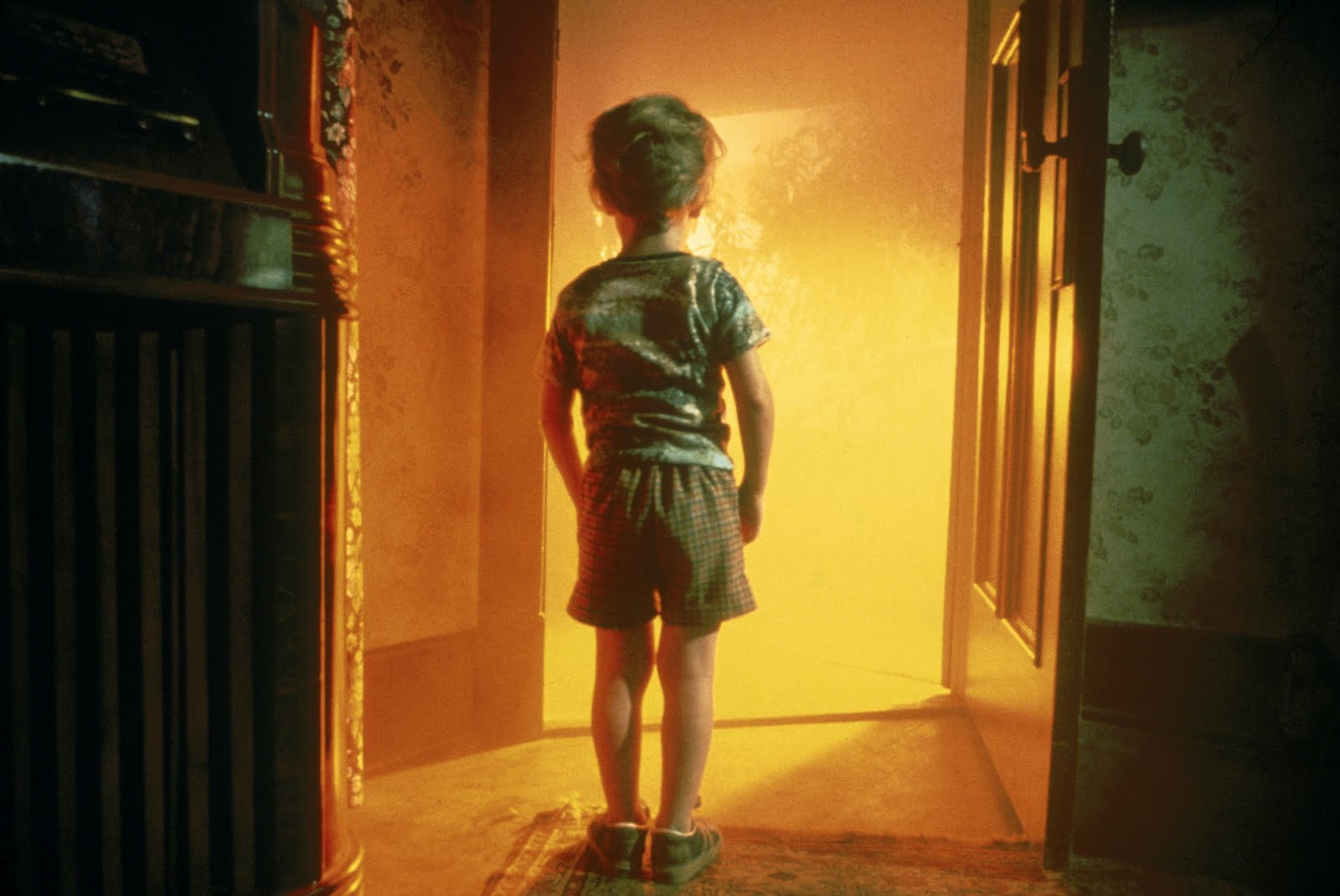
Look into the light


Close Encounters of the Third Kind (1977)


Raiders of the Lost Ark (1981)


E.T.: The Extra-Terrestrial (1982)


Poltergeist (1982)


Empire of the Sun (1987)


Schindler's List (1993)


A.I. Artificial Intelligence (2001)


War of the Worlds (2005)

Super 8 (2011)

Sunday, June 12, 2011

"Somewhere"


When he's not making snide remarks about the hit TV musical Glee (I believe he said it made him feel like he'd "just stepped into a puddle of HIV"), cult author Bret Easton Ellis usually tweets in a totally civilized manner about his current pop-culture preferences. Last January, he tweeted: "Long talk with angry, successful screenwriter yesterday about our admiration for 'Somewhere' and how its images have haunted us for weeks..."

I share Ellis' enthusiasm for the haunting imagery in Somewhere, the latest film written and directed by Sofia Coppola. Like Ellis, Coppola is often accused of making shallow art about spoiled rich people, and Somewhere won't change anybody's mind. The picture is best appreciated as a purely aesthetic experience; if you approach it any other way, it's bound to try your patience.


Stephen Dorff, an actor I've always admired because he was in two early-'90s movies I grew up loving (Judgment Night and Backbeat), plays Johnny Marco, a movie star whose personal life suffers as his professional life flourishes. His tween daughter, Cleo (Elle Fanning), is left in his custody for the weekend, and the two of them spend the movie hanging out in five-star hotels. At one point, they fly halfway around the world to attend a glitzy awards show, and their suite actually has a swimming pool in it, like Francis' bathtub in Pee-wee's Big Adventure.

I can certainly see where critics are coming from when they say Coppola seems a little, uh, out of touch. In a particularly nasty review of her 2006 film, Marie Antoinette (a delicious piece of eye candy that I find slightly alienating), the reviewer refers to her as "arguably the most successful living member of the Lucky Sperm Club." (Her dad is legendary movie director Francis Ford Coppola). And, because I love snarky reviews, let me quote some more: "Without daddy’s money backing up her efforts, Coppola’s emaciated screenplay would still be moldering on her hard drive as the author worked the 10-4 shift at the Starbucks on Figueroa." Fun to read, but not exactly true. It's easy to question Coppola's abilities as a screenwriter, but harder to dismiss her talent as an image maker. And so what if her films are about the rich and the famous? If you want stories about the working class, check out Mike Leigh or Ken Loach.


The relatively brief plot description I've included here doesn't skimp on the details. Nothing much *happens* in Somewhere; the opening shot of a Ferrari circling endlessly around a barren stretch of road should be taken as a warning to some viewers to stay away. The movie fits nicely into an ongoing debate in certain cinephile circles – sparked by a recent NY Times Magazine piece by Dan Kois, who's been criticized by Manohla Dargis and A.O. Scott and Glenn Kenny – about "slow cinema". Somewhere is like Coppola's homage to the anti-narrative indies of Jim Jarmusch and Gus Van Sant. I don't find her film as maddening as Jarmusch's The Limits of Control, nor do I find it as compelling as Van Sant's Death Trilogy. (Nothing as dramatic as dying happens in Somewhere.) Overall, I was grateful that the film offered me, in the words of Dargis, the opportunity to "meditate, trance out, bliss out, luxuriate in your thoughts, think."

As for the image that haunted me the most, it would have to be an extended shot of Johnny in a makeup chair. He's being prepped to play an elderly version of himself for his next project, and we see him as a totally blank slate, his face an eerie reflection of the emptiness he feels inside. That moment is not merely the product of "lucky sperm"; it shows an artist honing her craft. Coppola's talent is evident in everything from her casting choices (Dorff and Fanning are wonderful together) to her soundtrack selections, which never fail to amaze me. I've included a few samples below: a dreamy track by the Strokes and the opening-titles song by Phoenix (Coppola is engaged to frontman Tom Mars, whose band provides most of the music in Somewhere).


Sunday, June 5, 2011

Undead and Not Loving It


In the recent DOA comic-book movie, Dylan Dog: Dead of Night, Sam Huntington plays Marcus, a motor-mouthed paranormal investigator who gets killed off early on in the film and comes back as a zombie. Marcus' postmortem plight – his diet consists of worms and maggots – got me thinking about some of the unhappier undead movie characters. Here are some of my all-time favorites:

Louis de Pointe du Lac, Interview with the Vampire


On my ancient DVD copy, director Neil Jordan introduces Interview with the Vampire as "a movie about the saddest vampires you've ever seen." The saddest of the sadsacks is Louis (Brad Pitt), a bloodsucker with a conscience who feeds on rats, chickens and poodles because he refuses to kill another human being. A close second is Claudia, a prepubescent immortal played by Kirsten Dunst, who laments that she will "never ever grow up." These milquetoast vampires are almost TOO melancholy; when Louis and Claudia's gleeful maker, Lestat (Tom Cruise, in a flamboyant, expansively entertaining performance) exits the picture, the movie pretty much falls apart.

Jerry, The Prophecy


I remember being really excited to see this when it came out my sophomore year of high school. I'd seen Pulp Fiction about 20 times by then, and The Prophecy features three Tarantino alums (Eric Stoltz, Christopher Walken and Amanda Plummer). In addition to Walken's homicidal archangel Gabriel, the character I was most struck by was Jerry (Adam Goldberg), a sardonically depressed young man who's kept in limbo by Gabriel after committing suicide. Ol' Gabe has nothing but disdain for the human race, but he keeps Jerry not-quite-alive because "it's a big universe and some things in it are talking monkey work." Walken and Goldberg have a very funny onscreen rapport; they provide the only comic relief in this otherwise grim horror picture, one of the ickiest cinematic Bible stories to come along before The Passion of the Christ.

Ray Lynskey, The Frighteners


The main thing you need to know about Ray Lynskey (Peter Dobson) is that he's the only person who cries at his own funeral. "It's a goddamn tragedy!" he sobs, even while he's remembered as "less than generous" by those he left behind. A skeptic who has to become a ghost to believe in ghosts, Ray refuses to take the Corridor of Life to heaven because, as he explains, he's "only 29!" As an earthbound emanation, he ultimately gets to redeem himself; he clearly loves his wife, Lucy (Trini Alvarado) and tries to save her. Unfortunately for him, no good deed goes unpunished in this wicked Peter Jackson-directed horror-comedy, the second-best genre mashup of 1996 (after From Dusk Till Dawn, of course).

Moaning Myrtle, Harry Potter and the Goblet of Fire


Poor, poor Moaning Myrtle. She's destined to haunt the girls' bathroom at Hogwarts School of Witchcraft and Wizardry. (As haunting places go, bathrooms must be among the most unpleasant.) A bullied teen who was murdered by Tom Riddle himself, Myrtle is a genuinely tragic figure, but as played by the pixieish actress Shirley Henderson in the movies, she's mostly a source of annoyance and bemusement for Harry and his friends. Technically speaking, Myrtle plays a bigger part in Chamber of Secrets, but the Chris Columbus-directed Harry Potter movies are dead to me. Besides, she's a much more well rounded character in Goblet, as she helps Harry decipher a riddle that will lead him to winning the Triwizard Tournament.

Zia, Wristcutters: A Love Story


"Soon after I killed myself I got a job here at Kamikaze Pizza." Thus begins one of my favorite black-comic visions of the afterlife, right up there with Albert Brooks' Defending Your Life. Zia (Patrick Fugit) slits his wrists after his girlfriend dumps him and ends up in a dreary place populated by people who have committed suicide, where there are no stars in the sky and nobody ever smiles. (Sounds like South Florida - zing!) Like Moaning Myrtle, Zia was unhappy in real life and he's unhappy in the afterlife, suggesting that people are not only the same backwards and forwards but also alive and undead. But, as the title suggests, Wristcutters is a love story, and with Cupid's Arrow comes an opportunity for rebirth.